Components / Fuses

Fuses: Current, Speed and Interrupting Rating

Read time-current behavior, voltage rating and breaking capacity.

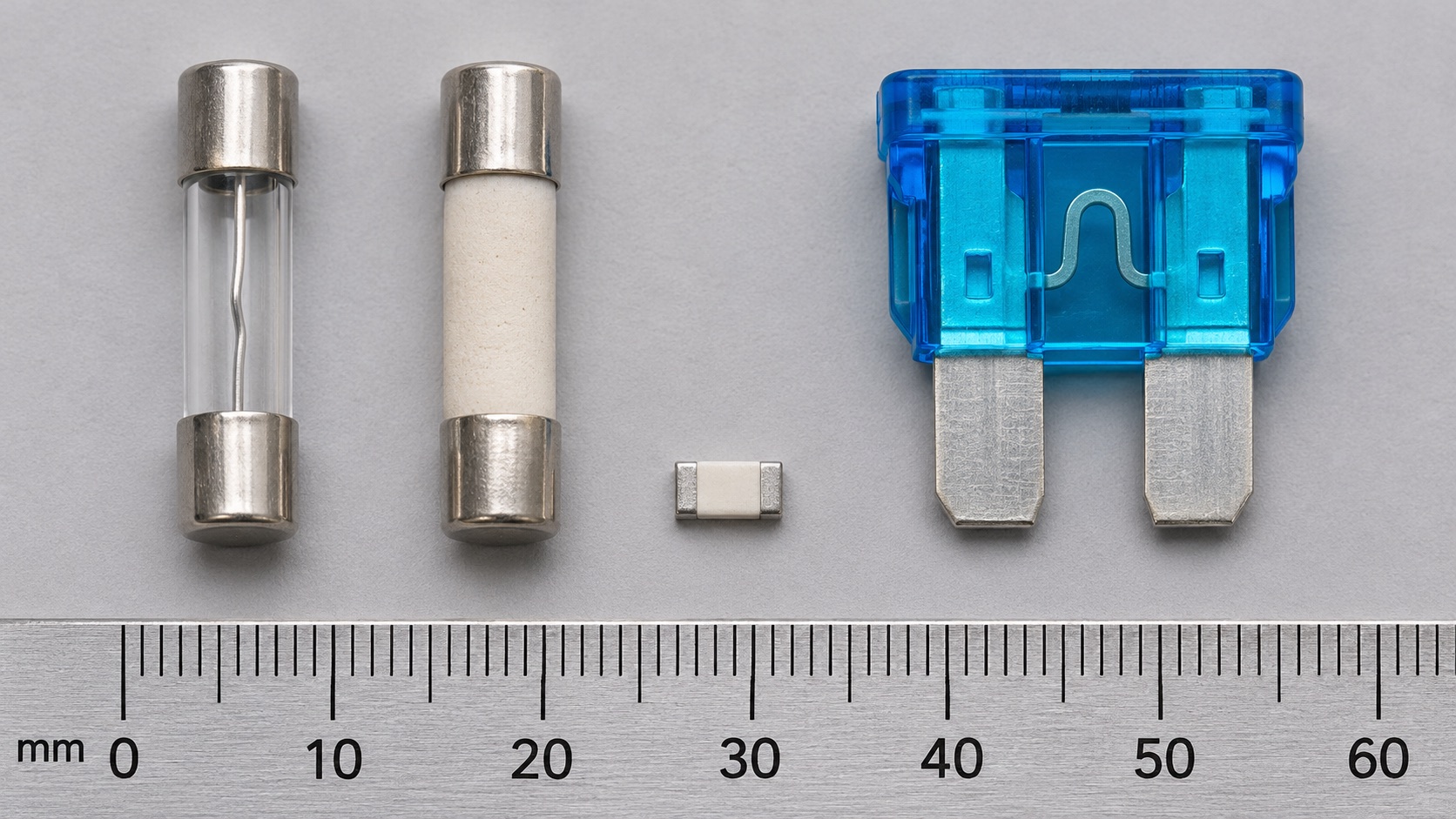
Illustrated fuse forms: glass cartridge, ceramic cartridge, surface-mount chip and automotive blade fuse
Appearance illustration of 4 common physical forms. Generated for teaching, not a photograph of the models below; size and markings are not exact. See the in-site model notes for verified details.

Recognise and choose

What forms will you encounter?

01Transparent cylinder, left

Glass cartridge fuse

How to recognise it
Visible element inside a glass tube with metal end caps.
Use it when
Serviceable supplementary protection when a matching holder and fault rating are available.
Check before choosing
Dimensions, current, AC/DC voltage, breaking capacity and time-current curve.

Model notes on this siteLittelfuse 217 series (5 × 20 mm fast acting) →

02Opaque white cylinder, centre-left

Ceramic cartridge fuse

How to recognise it
Opaque ceramic tube with metal end caps; the element cannot be inspected through the body.
Use it when
Serviceable circuits requiring the exact ceramic series’ surge and interrupting behaviour.
Check before choosing
Do not infer breaking capacity or speed from the white body; use the exact datasheet.

Model notes on this siteLittelfuse 215 series (5 × 20 mm time delay) →

03Tiny rectangular part, centre

Surface-mount fuse

How to recognise it
Small PCB chip or moulded block with solderable ends.
Use it when
On-board protection in compact assembled electronics.
Check before choosing
Current and voltage ratings, time curve, breaking capacity, footprint and replacement method.

Model notes on this siteLittelfuse 451/453 Nano² series →

04Coloured plastic body with two blades, right

Automotive blade fuse

How to recognise it
Translucent coloured housing and two flat metal blades.
Use it when
Vehicle and other compatible low-voltage fuse-block circuits.
Check before choosing
Exact blade size, current code, DC voltage rating, holder and fault current.

Model notes on this siteLittelfuse ATOF / 287 series →

At a glance

A fuse opens a circuit after enough overcurrent energy has passed. Its current rating is not an instant-trip threshold.

This guide explains a component family. Check the exact part number and manufacturer datasheet before building.

Key specifications

Rated current
Nominal current under stated conditions
Rated voltage
Maximum specified circuit voltage
Interrupting rating
Maximum fault current it can safely break
Time-current curve / I²t
Opening behavior under overloads and surges

Circuit Lab

Put this component into a circuit

Why does a fuse not open instantly at its marked current?

Change
Rated current, overload multiple, pulse duration and fuse curve
Observe
Time-current comparison and I²t concept

This describes a learning model for a future experiment. Device-specific limits still come from the linked datasheets.

How it works

A fuse element heats under current and melts when its time-current characteristic is exceeded. Fast and time-delay types respond differently to inrush. The prospective short-circuit current and circuit voltage must be within the fuse’s ratings.

Types and construction

Cartridge, surface-mount and automotive fuses have different approvals, holders and operating conditions. A resettable polymer PTC is a different protection device and has different trip and reset behavior.

Worked example

A load that draws 1 A continuously can briefly draw more during startup. Selecting a fuse solely because it says “1 A” is insufficient: compare the measured startup pulse with the series time-current curve and verify ambient derating and the available fault current.

Reading a datasheet

Read AC and DC voltage ratings separately, interrupting rating at that voltage, current derating, time-current graph, melting I²t, agency approvals and holder compatibility. Check the protected circuit’s available fault current.

Common mistakes

  • Treating rated current as an exact trip point.
  • Substituting a fuse with insufficient breaking capacity.
  • Replacing a time-delay type with a fast type without checking normal inrush.

Explore further

Source and review

Reviewed 18 November 2026 against Littelfuse, Fuseology Design Guide. Examples are simplified educational models; ratings and pinouts depend on the exact device.