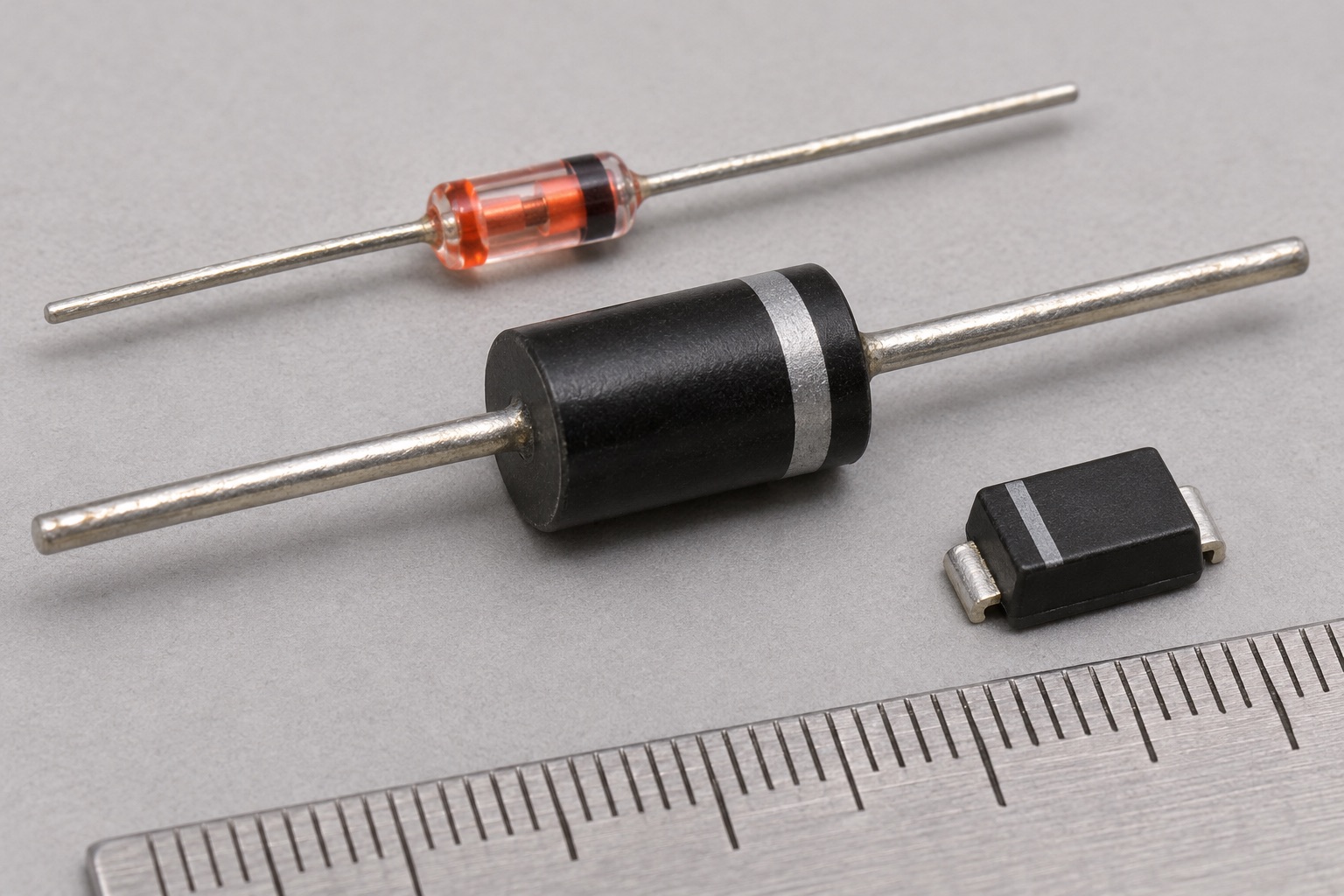
Understand forward conduction, reverse blocking, current and recovery ratings.
How it works
A forward-biased diode has a current-dependent voltage drop, so a fixed 0.7 V model is only a rough circuit estimate. Reverse-biased current is small within the specified range, but excessive reverse voltage can cause breakdown.
Types and construction
Small-signal switching diodes, power rectifiers, Schottky diodes and Zener diodes serve different purposes. Schottky parts can switch quickly and often have lower forward drop, but their reverse leakage and voltage limits still need checking.
Worked example
A 1N4148 can steer a small signal, but it is not a generic high-current rectifier. Its manufacturer datasheet states 100 V continuous reverse voltage and 200 mA continuous forward current under specified mounting conditions; these numbers do not transfer to other “1N4148” packages or suppliers.
Reading a datasheet
Read the exact part number, package and polarity drawing. Check reverse voltage, continuous and surge forward current, Vf at relevant current, leakage at temperature, recovery time and thermal limits.
Common mistakes
- Treating the stripe or schematic symbol as proof of every package pinout.
- Assuming a universal 0.7 V forward drop.
- Using a signal diode at power-rectifier current or ignoring surge current.
Explore further
Source and review
Reviewed 18 November 2026 against Nexperia, 1N4148/1N4448 datasheet. Examples are simplified educational models; ratings and pinouts depend on the exact device.